Table of Contents
- Sliding Scale Rehab: Making Addiction Treatment Accessible in Newtown, Pennsylvania
- How Sliding Scale Rehab Works and Who It Serves
- Qualifying for Sliding Scale Fees and the Income Assessment Process
- Finding Sliding Scale Rehab in Pennsylvania and Across the United States
- Dual Diagnosis and Holistic Care in Sliding Scale Programs
- Frequently Asked Questions About Sliding Scale Rehab
- Your Next Step Toward Affordable Recovery in Newtown, Pennsylvania
Sliding Scale Rehab: Making Addiction Treatment Accessible in Newtown, Pennsylvania
At Rosewood Recovery, we believe that cost should never be a barrier to getting help. Our sliding scale rehab adjusts fees based on your income and ability to pay, making quality addiction treatment in Pennsylvania accessible to everyone.
Our income based rehab options extend across our Partial Hospitalization Program (PHP), Intensive Outpatient Program (IOP), and General Outpatient Program (OP). Our team works with you to determine a manageable fee structure, so you can focus on your recovery without financial stress.
Residents throughout Bucks County and Pennsylvania can access treatment that addresses both substance use and co-occurring mental health conditions. Our sliding scale approach supports dual diagnosis rehab, ensuring comprehensive care for underlying issues. As recognized by the Substance Abuse and Mental Health Services Administration (SAMHSA), financial flexibility is key to successful treatment access. By removing financial barriers, we help more individuals in Newtown and across Pennsylvania begin their journey towards healing and sobriety.
Recovery Begins Here. If you're ready to start your treatment, we invite you to schedule a consult call to discuss our sliding scale options and income-based rehab plans. Results may vary based on individual patient factors and circumstances, but taking the first step is the most important decision you can make. We encourage you to begin your journey towards happiness and freedom today. When you call, your information is kept confidential and protected by our HIPAA-compliant privacy policy.
How Sliding Scale Rehab Works and Who It Serves
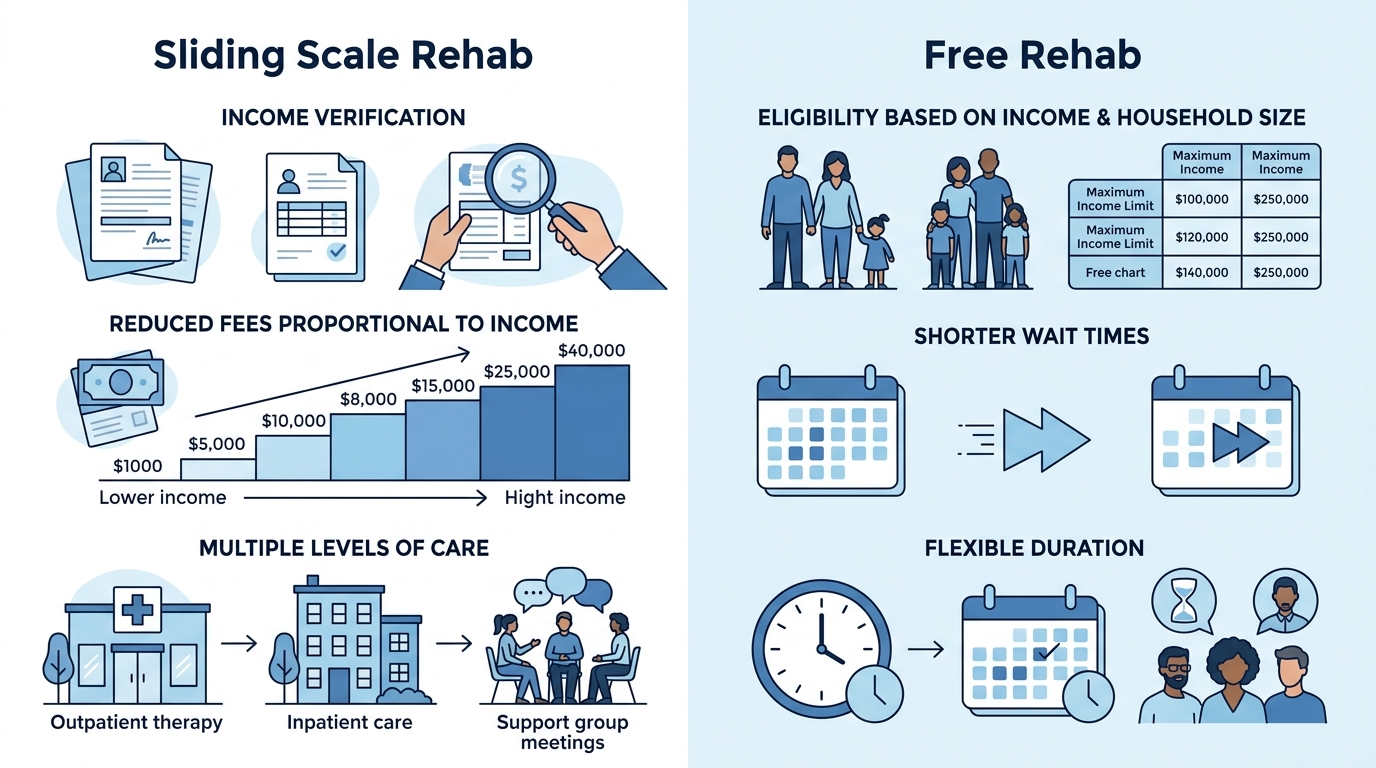
Sliding scale rehab is a payment model that adjusts the cost of addiction treatment based on your income and household size, making professional care accessible to more people. Unlike fixed-price programs, sliding scale rehab in Pennsylvania offers income-adjusted treatment fees so that financial limitations do not stand between you and the help you need. At its core, this approach ensures that quality addiction treatment remains within reach for individuals and families who might otherwise delay or forgo care due to cost concerns. By reducing financial barriers, these need-based payment plans open the door to structured, evidence-based recovery.
To qualify for a sliding scale fee, you will typically need to provide proof of income, such as recent pay stubs or tax returns. The facility calculates a reduced rate proportional to your earnings and household size, so you pay what you can reasonably afford. Many people find that sliding scale arrangements make the difference between getting treatment and continuing to struggle. The comparison below highlights how this model differs from free rehab programs across several key factors.
Comparison: Sliding Scale vs. Free Rehab Programs
| Feature | Sliding Scale Rehab | Free Rehab |
|---|---|---|
| Eligibility Criteria | Based on income and household size | Often limited to very low income or specific populations |
| Cost to Patient | Reduced fee proportional to income | No cost to patient |
| Level of Care Options | Usually offers PHP, IOP, OP, detox | May have limited levels of care or longer wait times |
| Wait Times | Moderate; sliding scale facilities may have shorter waits than free programs | Often long wait lists due to high demand |
| Duration of Treatment | Can be extended; length determined by clinical need | May be limited to fixed short‑term programs |
| Insurance / Payment Flexibility | May accept insurance + sliding scale private pay | Typically no insurance accepted; government or grant funded |
The comparison shows that sliding scale rehab provides significantly more flexibility than free programs. While free rehab charges nothing, it often comes with lengthy wait lists and rigid treatment durations that may not suit your needs. Sliding scale programs generate some revenue, allowing facilities to maintain shorter wait times and offer a broader continuum of care, including step-up and step-down transitions.
Sliding scale rehab fills a crucial middle ground for people who earn too much to qualify for free programs but cannot afford full-price private treatment. This includes uninsured individuals, those with high-deductible health plans, and families with limited budgets. Income based rehab is particularly valuable for working adults who need to maintain employment while attending treatment, since programs like Partial Hospitalization and Intensive Outpatient allow you to return home in the evenings. Many sliding scale facilities also offer dual diagnosis rehab, addressing co-occurring mental health conditions such as anxiety, depression, or trauma alongside substance use disorders. According to industry resources like Hashtag Addiction Resources, Pennsylvania PHP programs integrate mental health and addiction treatment within the same clinical framework, ensuring neither condition is overlooked during recovery.
At Rosewood Recovery, we offer multiple levels of care, including PHP, IOP, and general outpatient services, all accessible through our sliding scale arrangements. This flexibility means you can start at the appropriate intensity and transition to less structured care as your recovery progresses, without financial worries forcing an early discharge.
Rehabilitación con tarifa variable: proceso y comparación con opciones gratuitas.
If you are looking for affordable treatment in Pennsylvania, our outpatient addiction programs in Pennsylvania can work with your budget. Recovery Begins Here. Contact Rosewood Recovery today to schedule a consult call and begin your journey towards happiness and freedom. Individual results are not guaranteed and depend on many factors including commitment to treatment. We maintain strict HIPAA compliance to protect your privacy throughout the assessment process.
Qualifying for Sliding Scale Fees and the Income Assessment Process
Understanding how to qualify for our sliding scale rehab program is the first step toward accessing affordable, quality care. We want to make the process as straightforward and supportive as possible, so you can focus on what truly matters—your healing. Our income based rehab options are designed to ensure that financial circumstances do not stand in the way of getting the help you deserve, and we’re here to guide you through every part of the application.
Documentation and Confidentiality for Sliding Scale Qualification
To determine your eligibility for income-sensitive treatment costs, we ask you to provide a few standard documents that verify your household income and number of dependents. This typically includes recent pay stubs, the previous year’s tax return, or other proof of income such as a benefits statement. The Substance Abuse and Mental Health Services Administration (SAMHSA) notes that transparent income verification is a common practice for programs offering financial assistance, helping providers tailor fees fairly to each client’s unique situation.
We handle your personal information with the utmost care and confidentiality. All documentation you submit, including your income assessment, is protected under HIPAA regulations. Our team reviews your materials in a private, secure setting, and we never share your financial details with anyone outside our clinical and administrative staff who need it for the assessment. To make this step even easier, we offer a no-cost initial consultation where we can discuss sliding scale availability, answer your questions, and begin the qualification review without any commitment.
The following table illustrates typical income brackets and the corresponding fee percentages, using a hypothetical $15,000 program as an example. These figures are meant to give you a general idea of how affordable addiction care can work, but actual fees are determined after your individual assessment.
Example Sliding Scale Fee Schedule
| Household Income (Annual) | Number of Dependents | Typical Fee Percentage | Example Monthly Cost (for $15,000 program) |
|---|---|---|---|
| Under $20,000 | 1–2 | 10%–20% | $1,500–$3,000 |
| $20,000–$35,000 | 1–3 | 20%–35% | $3,000–$5,250 |
| $35,000–$50,000 | 2–4 | 35%–50% | $5,250–$7,500 |
| Over $50,000 | Varies | 50%–full fee | $7,500–full price |
These percentages are based on household size and annual income, and they align with general guidance issued by SAMHSA regarding sliding fee structures. Please remember that these are examples only; your actual fee will be discussed with you after our confidential review.
Applying Sliding Scale Fees to Different Treatment Programs
We believe that financial flexibility should extend across every level of care we provide. Whether you need the structured support of a Partial Hospitalization Program (PHP), the balance of an Intensive Outpatient Program (IOP), or the ongoing guidance of a General Outpatient Program (OP), our sliding scale fees are applied consistently. This means that when your income and dependents are assessed, the resulting fee percentage is used to calculate your cost regardless of which program is clinically appropriate for you.
For individuals who require dual diagnosis rehab to address both substance use and co-occurring mental health conditions, the sliding scale also applies. Our goal is to remove financial barriers so you can access the exact level of treatment you need, from more intensive day programs to flexible outpatient sessions. According to the Substance Abuse and Mental Health Services Administration, integrated treatment for dual disorders is essential for long-term recovery, and we want that care to be within reach for everyone in our community.
Results may vary based on individual patient factors and circumstances, and the sliding scale is subject to availability and individual assessment. This information is for educational purposes and not a substitute for professional medical advice.
A Step-by-Step Guide to Requesting Sliding Scale at Rosewood Recovery
Taking the first step toward affordable treatment is simple, and we’re here to support you along the way. If you are seeking addiction treatment in Pittsburgh, our sliding scale options make care more accessible. Here’s how to get started:
- Reach out to us. Contact Rosewood Recovery by phone or through our website to express your interest in learning more about our programs and the sliding scale availability.
- Ask about the sliding scale. Let our admissions team know you’d like information on income-based fees. We’ll explain the assessment process and answer any questions without any obligation.
- Schedule a no-cost initial assessment. We’ll set up a time for your free consultation, where we can discuss your treatment needs and walk you through the upcoming steps.
- Submit the required documents. Provide your pay stubs, tax return, or other proof of income along with dependent information. Our confidential review is completed quickly and in full compliance with HIPAA privacy standards.
- Receive your individualized fee determination. After the review, we’ll discuss your fee percentage and how it applies to the treatment program recommended for your recovery.
Once your sliding scale is in place, you can confidently begin your journey towards happiness and freedom, knowing that your care plan fits both your clinical needs and your budget. Our dedicated team will help you schedule a consult call and start your treatment in a program that feels right for you. Please note that eligibility is determined only after the income assessment, and we cannot guarantee a specific fee until that process is complete. Recovery Begins Here, and we’re honored to walk this path with you.
Please consult with a healthcare provider for professional advice regarding treatment options. Individual results are not guaranteed and depend on many factors including commitment to treatment.
Finding Sliding Scale Rehab in Pennsylvania and Across the United States
Now that you know the basics, let’s walk through how to find and secure sliding scale rehab in Pennsylvania and nationwide.
Using Online Directories to Find Sliding Scale Rehab
The SAMHSA website provides a comprehensive directory of substance abuse treatment resources where you can filter by payment type. Select "Sliding Fee Scale" and pick Pennsylvania to generate a list of facilities. You can further narrow by city, program type (outpatient, detox), or even by dual diagnosis rehab if you need integrated care for co-occurring disorders. If you’d rather speak with someone, the SAMHSA National Helpline at 1-800-662-4357 is available 24/7 and can guide you to income-based rehab options. Beyond SAMHSA, state directories like the Pennsylvania Department of Drug and Alcohol Programs also include sliding scale filters. Remember that online listings aren’t always current—always call a facility directly to confirm sliding scale eligibility for the exact program you need, whether it’s PHP, IOP, or general outpatient. This two-step approach (directory search followed by a phone call) saves time and ensures you connect with truly accessible care. Many residents from Pittsburgh to Philadelphia rely on these tools, and Rosewood Recovery’s Newtown facility appears in many of these listings as well. Taking a few minutes to verify can make all the difference.
Questions to Ask When Inquiring About Sliding Scale Options
When you contact a facility, having a set of key questions ready can make the conversation more efficient and help you gauge fit. We recommend asking these:
- Do you offer a sliding scale for your treatment programs?
- Is the sliding scale available for all levels of care, including PHP, IOP, and OP?
- What income documentation do you require (pay stubs, tax returns, bank statements)?
- How often is the sliding scale fee recalculated?
- Are holistic therapies like yoga and mindfulness included in the sliding scale rate?
- Is there a waitlist for sliding scale spots, and what is the typical wait time?
- Can I schedule a tour of your facility?
- If I have insurance, can I combine it with the sliding scale?
- Do you treat dual diagnosis rehab (co-occurring mental health) under the sliding scale?
By asking these questions, you’ll get a clear picture of the financial commitment and the scope of services covered. We also suggest verifying that the sliding scale applies to the specific program you’re considering, as policies can differ even within the same facility. A quick call can prevent surprises later. Some facilities may require you to re-apply periodically, so ask about that upfront as well. You can also ask about dual diagnosis rehab coverage during the call to ensure all your needs are met. Don’t hesitate to reach out to multiple providers—comparing options helps you find the best fit. Reputable centers welcome these financial conversations and respect your need for transparency.
Rosewood Recovery’s Sliding Scale Treatment Programs
Before we explain how we simplify things at Rosewood Recovery, take a look at our sliding scale-eligible outpatient programs:
| Program Feature | Partial Hospitalization (PHP) | Intensive Outpatient (IOP) | General Outpatient (OP) |
|---|---|---|---|
| Hours per Week | 20–30 hours | 9–15 hours | 3–6 hours |
| Therapy Types | Individual + Group + Holistic | Individual + Group + Holistic | Individual + Group |
| Sliding Scale Eligible | Yes | Yes | Yes |
| Dual Diagnosis Support | Integrated co‑occurring treatment | Integrated co‑occurring treatment | Integrated co‑occurring treatment |
| Best For | High‑intensity step‑down from detox | Those needing structured evening/day care | Long‑term maintenance and less acute needs |
All levels integrate dual diagnosis support and evidence-based therapies, so you can find the right intensity for your recovery.
How Rosewood Recovery Streamlines the Sliding Scale Process
When you’re ready to take the next step, Rosewood Recovery makes the sliding scale application simple and stress-free. Just give us a call or fill out our online form, and a compassionate admissions specialist will set up a no-cost initial assessment. This confidential phone call is where we learn about your income and financial situation—it’s not a credit check or a complicated application; we just need recent pay stubs, tax returns, or a written statement if your income varies. Our dedicated support team is by your side throughout the paperwork process, helping you gather documents and clarifying any questions you have. Usually, we can determine your sliding scale eligibility within a few business days. Once approved, we’ll work with you to select the right level of care—whether that’s our Partial Hospitalization Program, Intensive Outpatient Program, or General Outpatient Program—all of which are eligible for the sliding scale and include holistic therapies like yoga and mindfulness. As Hashtag Addiction Medicine notes, these integrative practices can support recovery, and we’ve built them into our income-based rehab plans without extra fees. For those with co-occurring mental health conditions, our dual diagnosis rehab approach ensures integrated care as part of your sliding scale plan. We invite you to visit our facility at 12 Penns Trail, Newtown, PA 18940 to meet our team and see our welcoming environment. There’s no pressure to commit during that first call—our priority is simply to understand your needs and answer your questions. To get started, visit our website or call the number on our official contact page. We believe recovery should be accessible, and our income-based rehab approach reflects that commitment. Individual results are not guaranteed and depend on many factors, including how actively you engage in the treatment plan.
Dual Diagnosis and Holistic Care in Sliding Scale Programs
For those also dealing with a co-occurring mental health condition, a sliding scale rehab program can provide the integrated care needed to address every aspect of well-being. An income based rehab like ours ensures that financial limitations do not stand in the way of receiving comprehensive treatment for both substance use and mental health.
True healing requires more than just addressing addiction symptoms. Dual diagnosis rehab is a specialized approach that treats substance use disorders and co-occurring mental health conditions—such as anxiety, depression, or trauma—within a single, coordinated program. This method acknowledges that these challenges are often deeply intertwined, and lasting recovery depends on healing both simultaneously. When this integrated clinical care is paired with holistic therapies, the treatment journey becomes truly transformative, nurturing the physical, emotional, mental, and spiritual dimensions of a person.
At Rosewood Recovery, we believe that effective care should be accessible to everyone in our community. We offer sliding scale addiction treatment through a financial hardship program, making our full continuum of care more affordable. This income-sensitive treatment model is available across all of our programs, including our Partial Hospitalization Program (PHP), Intensive Outpatient Program (IOP), and General Outpatient Program (OP). This means you can access the right level of structured support without the added stress of an overwhelming financial burden.
Our commitment to whole-person healing is woven into every treatment plan. We integrate holistic and somatic therapies—such as yoga, mindfulness, breathwork, and somatic experiencing—to help you reconnect with your body and calm your nervous system. These practices, combined with evidence-based clinical interventions, can support your recovery by teaching essential skills for managing stress and regulating emotions. In Pennsylvania, many individuals face financial barriers to care, but a co-occurring disorder care program with a sliding scale can make this vital, integrated support a reality.
Individual results are not guaranteed and depend on many factors including commitment to treatment. Please consult with a healthcare provider for professional advice. To see if you qualify, reach out to our team and start your treatment today. Recovery Begins Here; take the first step and schedule a consult call to begin your journey towards happiness and freedom.
Frequently Asked Questions About Sliding Scale Rehab
- What is sliding scale rehab? Sliding scale rehab is an income-based fee system that makes treatment affordable. We set your rate through a confidential assessment in Pennsylvania.
- Who qualifies for income-based rehab at Rosewood Recovery? Eligibility is based on your confidential assessment. We offer income based rehab options that match your ability to pay in the Newtown area.
- Which treatment programs use sliding scale rehab? Every level of care—PHP, IOP, OP—qualifies for sliding scale rehab, including holistic therapies, providing full treatment near Newtown.
- Is dual diagnosis rehab available with sliding scale payment? Yes—dual diagnosis rehab is integrated into our sliding scale, covering both addiction and mental health treatment.
- How do I apply and schedule a consult? Ready to start? Schedule a free consult. We’ll guide you through the assessment and begin your journey towards happiness and freedom.
Individual results are not guaranteed and depend on many factors including commitment to treatment.
Your Next Step Toward Affordable Recovery in Newtown, Pennsylvania
With these options in mind, taking the next step is easier than you think. Our sliding scale rehab and income based rehab fees make quality care accessible right here in Newtown, Pennsylvania. We also provide dual diagnosis rehab for those facing co-occurring mental health challenges, ensuring whole-person support.
Recovery Begins Here — schedule a consult call today, and let our team help you begin your journey. Individual results may vary, but we’ll guide you every step of the way.
Resources
- Discover Holistic Addiction Treatment Options in Pittsburgh PA
- Explore Holistic Mental Health Treatment with Executive Programs
- Get PHP with Evidence-Based Therapies and Dual Diagnosis
- Find Holistic Outpatient Recovery with Local Support in PA
- Learn About Holistic Addiction Recovery with Town Guides
- Access SAMHSA National Helpline and Treatment Locator