Table of Contents
- What Is a Partial Hospitalization Program?
- PHP vs. IOP: Key Differences for Addiction Recovery
- Daily Structure in PHP Treatment: What to Expect
- PHP Services Available in Lehigh Valley and Pennsylvania
- Dual Diagnosis and Advanced Considerations in PHP
- Frequently Asked Questions About Partial Hospitalization Programs
- Taking the Next Step in Addiction Recovery
What Is a Partial Hospitalization Program?
For individuals who require daily clinical support but not round-the-clock supervision, a Partial Hospitalization Program offers a middle ground in the continuum of care. A partial hospitalization program (PHP) is a structured, intensive day treatment for substance use disorders that provides at least 20 hours of therapeutic programming per week, typically five to seven days a week, without requiring overnight stays. According to the Substance Abuse and Mental Health Services Administration (SAMHSA), PHP sits between inpatient residential treatment and standard outpatient care within the American Society of Addiction Medicine (ASAM) criteria, making it an evidence-based option for those who need substantial structure but are medically stable enough to live at home.
A PHP serves as either a step-down from residential treatment or a step-up from conventional outpatient therapy. It allows participants to engage in rigorous clinical work—including individual therapy, group counseling, family sessions, relapse prevention planning, and medication-assisted treatment (MAT) when appropriate—while returning to their personal residences each evening. This design helps individuals practice real-world coping skills while still anchored in daily accountability and professional guidance.
At Rosewood Recovery in Newtown, Pennsylvania, we deliver a Partial Hospitalization Program built on these same clinical principles. Our PHP combines evidence-based therapies with holistic approaches, reflecting our commitment to treating the whole person rather than just the symptoms of addiction. We create individualized treatment plans that address each person's unique needs in a supportive, community-oriented environment.
PHP is most appropriate for individuals who do not require 24/7 medical monitoring but still benefit from daily therapeutic structure. The intensive schedule reinforces healthy routines and coping strategies that form the foundation for lasting change. To understand how PHP differs from less intensive options, the next section examines partial hospitalization vs intensive outpatient in detail.
Results may vary based on individual patient factors and circumstances. This information is for educational purposes and not a substitute for professional medical advice.
PHP vs. IOP: Key Differences for Addiction Recovery
For many individuals beginning their recovery journey, understanding the different levels of care is an essential first step. A Partial Hospitalization Program (PHP) and an Intensive Outpatient Program (IOP) are two of the most common structured treatment options available, each designed for different stages of healing and levels of personal stability. In Newtown, Pennsylvania and throughout Bucks County, Rosewood Recovery offers both programs as part of our complete continuum of care, allowing clients to transition seamlessly without changing treatment communities.
A partial hospitalization program typically requires a commitment of 20 or more hours of treatment per week, often structured across five full days. This level of care provides high structure and daily medical and clinical supervision, making it the most intensive form of non-residential treatment. Clients in our PHP participate in a full schedule of therapeutic activities, including multiple daily group therapy sessions, individual counseling, holistic and somatic wellness practices, and often on-site meals. This immersion creates a supportive therapeutic environment that replicates many benefits of inpatient care while allowing clients to return home in the evenings.
In contrast, an intensive outpatient program requires 9 to 12 hours of weekly participation, usually distributed across three to five days. This schedule is designed with flexibility in mind, so individuals can balance their recovery work with employment, education, or family responsibilities. IOP provides a moderate level of structure with regular clinical check-ins rather than the continuous daily oversight characteristic of PHP. For someone with a stable living environment and a strong foundation in early recovery skills, this balance of accountability and autonomy can be the ideal next step.
The decision on whether to enter a partial hospitalization vs intensive outpatient program should always be made in partnership with a qualified treatment professional. The ASAM criteria addiction treatment framework, developed by the American Society of Addiction Medicine (ASAM), provides the industry standard for determining the appropriate level of care. According to ASAM's multidimensional assessment guidelines, placement is based on an individual's withdrawal potential, biomedical conditions, emotional and behavioral stability, readiness to change, relapse potential, and recovery environment. Our clinical team at Rosewood Recovery uses these evidence-based criteria during every initial consultation to recommend the program that best matches each client's unique needs and circumstances.
The following table compares the key features of PHP and IOP to crystallize the differences between these two levels of care:
| Feature | PHP | IOP |
|---|---|---|
| Weekly Time Commitment | 20+ hours per week (typically 5 days/week) | 9-12 hours per week (typically 3-5 days/week) |
| Level of Structure | High – structured daily programming, often includes meals and therapeutic activities | Moderate – flexible scheduling, fewer structured hours |
| Supervision | Medical and clinical supervision available daily | Regular check-ins but less daily oversight |
| Best Suited For | Individuals stepping down from inpatient or needing intensive daily support | Individuals with stable living environments who need ongoing support while maintaining work/school |
| Typical Duration | 4-8 weeks (average) | 8-12 weeks or longer depending on progress |
The clinical intensity of PHP makes it particularly appropriate for individuals transitioning from residential treatment or for those who require daily therapeutic support but do not need 24-hour medical monitoring. The structured daily routine helps establish healthy coping mechanisms and a strong recovery foundation during the vulnerable early stages of sobriety. In comparison, the longer typical duration of IOP reflects its role as a sustained support system, where clients can practice real-world application of recovery skills over several months while maintaining their professional and personal obligations. Both programs at Rosewood Recovery are co-occurring capable, meaning we address substance use disorders alongside mental health conditions like anxiety or depression in an integrated treatment approach.
Individual results are not guaranteed and depend on many factors including commitment to treatment. The step-down from PHP to IOP often occurs naturally within our treatment community, allowing clients to maintain continuity with their therapists and peer support groups as their clinical needs evolve and their stability increases. In the following section, we'll explore how you can seamlessly transition between levels of care at Rosewood Recovery. If you're ready to learn which program best fits your situation, we invite you to schedule a consult call with our team today. Recovery Begins Here.
Daily Structure in PHP Treatment: What to Expect
Now that you understand what a partial hospitalization program (PHP) is, let us walk through a typical day in the program at Rosewood Recovery. We have designed each day to provide structure, therapeutic engagement, and opportunities for personal growth, all while you return home in the evenings. This intensive level of care blends evidence-based clinical work with holistic practices, creating a balanced environment where healing can take root.
A Typical Day in PHP
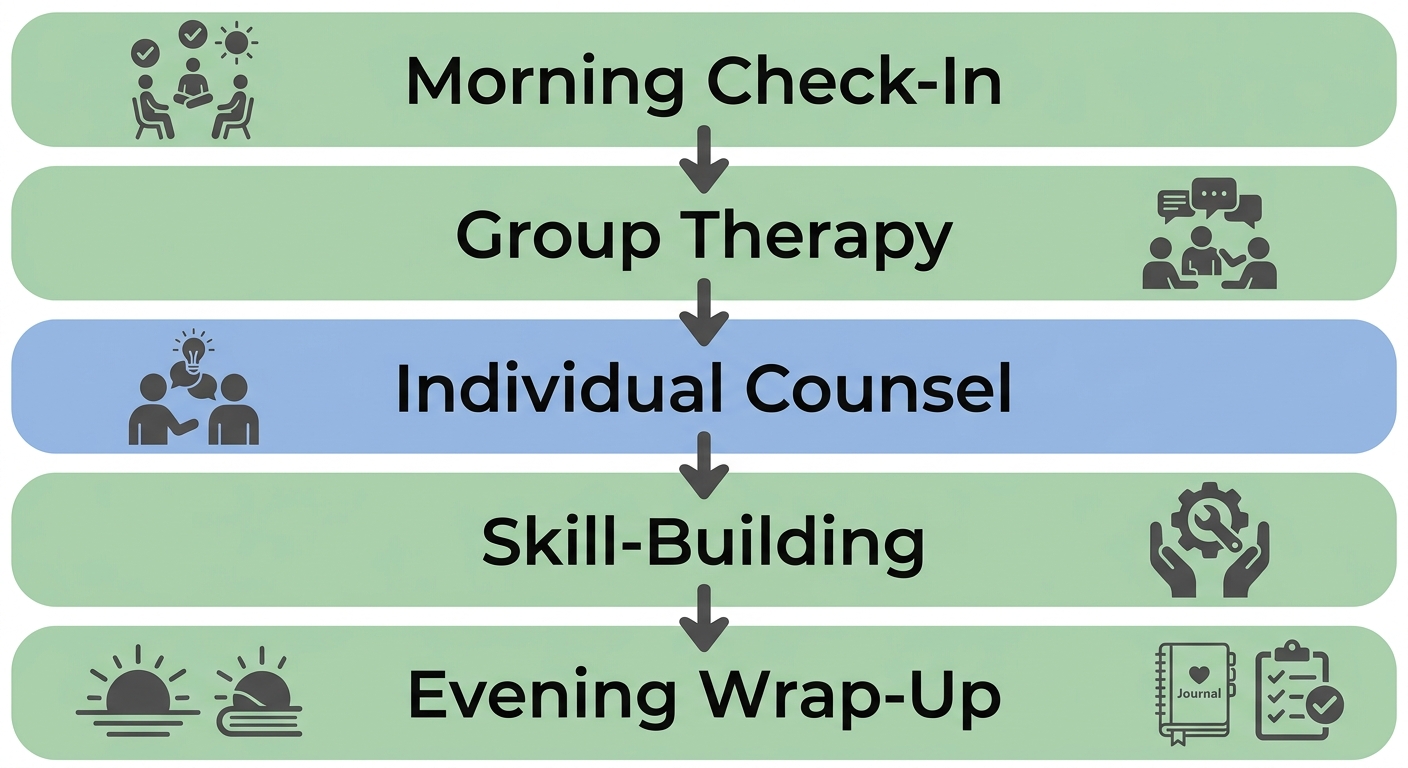
Your day in our partial hospitalization program begins with a morning check-in, a brief gathering that sets intentions and fosters a sense of community among peers. From there, we move into the first group therapy session of the day, often focused on processing emotions, sharing experiences, and building the interpersonal skills essential for lasting recovery. These groups are facilitated by experienced clinicians who guide conversations with empathy and clinical expertise.
Mid-morning transitions into individual counseling, where you work one-on-one with your assigned therapist. This private time allows for deeper exploration of personal challenges, trauma processing, and the development of targeted coping strategies. Following individual sessions, we incorporate skill-building groups that teach practical tools. These sessions might cover relapse prevention planning, communication techniques, or stress management workshops.
After a midday break, the afternoon focus shifts to holistic wellness. Our schedule includes activities like yoga, mindfulness meditation, and somatic awareness exercises to reconnect you with your physical body and regulate your nervous system. We wrap up the formal program day with an evening reflective group or wrap-up session, ensuring you leave feeling grounded and prepared. Throughout the day, we also support those needing partial hospitalization for dual diagnosis care, addressing both substance use and co-occurring mental health conditions in an integrated manner.

Daily structure in Rosewood Recovery Partial Hospitalization Program
Therapeutic Modalities Used in PHP
We rely on several evidence-based therapeutic modalities to drive your treatment forward, each selected for its proven effectiveness in helping people heal from addiction and mental health conditions. Cognitive Behavioral Therapy (CBT) is a cornerstone of our approach. This solution-focused method helps you identify and change the negative thought patterns that fuel substance use and emotional distress. In both individual and group settings, we use CBT to build practical coping skills you can apply immediately.
Dialectical Behavior Therapy (DBT) further strengthens your recovery toolkit with a focus on emotion regulation, interpersonal effectiveness, and distress tolerance. Our DBT skills training groups and individual coaching sessions teach you how to navigate intense feelings without turning to substances or harmful behaviors. For clients dealing with unresolved trauma, we also offer Eye Movement Desensitization and Reprocessing (EMDR) . This specialized therapy is integrated into your weekly schedule to help reprocess traumatic memories that may underpin addiction. These treatments are applied flexibly to meet you where you are.
The following table provides a quick overview of how these core modalities are used in our program.
| Modality | Focus | Application in PHP |
|---|---|---|
| Cognitive Behavioral Therapy (CBT) | Identifying and changing negative thought patterns | Individual and group sessions to build coping skills |
| Dialectical Behavior Therapy (DBT) | Emotion regulation, interpersonal effectiveness, distress tolerance | Skills training groups and individual coaching |
| Somatic Therapy | Body-awareness and trauma release | Holistic sessions integrated into weekly schedule |
By structuring our PHP around these proven methods, we empower you to build a resilient foundation for long-term wellness. Our programming aligns with the high standards recognized by the NAATP addiction treatment directory, reflecting a national commitment to ethical and effective treatment.
Holistic and Somatic Approaches
Healing in our PHP extends beyond the mind to include the body and spirit. Our holistic and somatic treatment philosophy recognizes that trauma and stress are stored physically, not just mentally. To address this, we weave mindfulness, yoga, and somatic experiencing into your weekly routine. These practices help regulate your nervous system, reduce cravings, and cultivate a deeper sense of internal safety.
Somatic experiencing, a key component of our approach, guides you to notice physical sensations and release stored tension gradually and safely. This can be particularly transformative for individuals who have found traditional talk therapy alone to be insufficient. During yoga and mindfulness sessions, we encourage you to be present in your body, quiet the mind, and build a nurturing relationship with yourself. This blend of Eastern and Western healing modalities creates a comprehensive treatment experience.
We believe this integrative care model is a powerful path to sustainable recovery for the whole person. Success during and after the program is a deeply personal journey. Individual results are not guaranteed and depend on many factors including commitment to treatment. Understanding the daily structure shows how PHP supports recovery around the clock, combining clinical depth with holistic renewal. Next, we will explore the advantages of this intensive yet flexible program and how to begin your journey towards happiness and freedom.
PHP Services Available in Lehigh Valley and Pennsylvania
Understanding the available treatment options is the first step toward healing. At Rosewood Recovery, we believe in meeting clients exactly where they are on their journey, and our partial hospitalization program (PHP) is designed to provide the structured, evidence-based care that many individuals need to build a solid foundation for recovery. Recovery Begins Here, and it begins with compassionate, personalized support. Our comprehensive partial hospitalization program in Pennsylvania bridges the gap between inpatient care and more flexible outpatient options, offering the intensity of daily clinical therapy while allowing you to return home each evening to practice new skills in a supportive environment.
Rosewood Recovery’s Newtown Facility
We are proud to offer our partial hospitalization program from our dedicated facility located at 140 Terry Drive, Newtown, PA 18940. Having opened its doors in January 2025, this modern, welcoming space was established to expand access to high-quality addiction treatment in the region. Our PHP treatment at this location provides a structured day of therapeutic programming, incorporating our unique blend of holistic and somatic therapy alongside individual and group counseling. This approach helps clients in Bucks County and the greater Philadelphia metro area address the underlying causes of addiction and develop practical, sustainable coping strategies in a safe and supportive setting.
Accessing PHP Services Across Pennsylvania
While our Newtown facility is a central hub, the benefits of a partial hospitalization program are accessible to individuals across a wide regional footprint. We proudly serve clients from the Lehigh Valley, Philadelphia, Bucks County, and surrounding Pennsylvania communities. For those considering what level of care is most appropriate, the difference between partial hospitalization vs intensive outpatient (IOP) often comes down to the need for structure. Our PHP is the ideal step-down from residential treatment or a direct-entry option for those needing full-day support, while our IOP offers more flexibility. For individuals managing co-occurring conditions, a partial hospitalization for dual diagnosis provides the integrated, simultaneous care necessary for effective, whole-person healing.
How to Start PHP Treatment
Taking the first step can feel daunting, but we’ve designed our admission process to be straightforward and supportive from the first call. Your journey begins with a free, confidential initial assessment conducted over the phone by one of our experienced treatment professionals. During this conversation, we’ll listen to your story, answer your questions, and help determine if our partial hospitalization program is the right fit for you. To begin, simply schedule a consult call with our team. We will guide you through every step so you can start your treatment with clarity and confidence, focusing your energy on what matters most: your healing.
The following table provides a quick overview of the PHP service delivery options available to you:
| Service Option | Availability | Ideal For |
|---|---|---|
| On-site PHP at Newtown, PA | Open since January 2025, daily programming | Local residents in Bucks County and nearby areas |
| Telehealth PHP components | Select groups and individual sessions available remotely | Clients with transportation limitations or scheduling needs |
For many, attending our on-site partial hospitalization program in Newtown provides the immersive, community-driven environment essential for early recovery. The daily face-to-face interaction with our clinical team and peers fosters a powerful sense of connection and shared purpose that can be profoundly healing.
Insurance Coverage for PHP
Navigating the financial aspect of treatment shouldn't be a barrier to getting help. Rosewood Recovery is committed to transparency and accessibility, and we accept a variety of insurance plans to cover our partial hospitalization program. Our dedicated team will conduct a complimentary, no-obligation insurance verification to determine your coverage and explain your benefits in clear, simple terms. For those facing financial hardship, we also offer a sliding scale fee structure to ensure cost is not an obstacle to critical care. Should you require additional support, you can also explore federal addiction treatment resources like the SAMHSA National Helpline for further guidance. Please remember, treatment outcomes depend on patient engagement and individual circumstances. This information is for educational purposes and not a substitute for professional medical advice.
As you consider the structure and support a partial hospitalization program provides, the next step is understanding how this approach compares to other levels of care. In the following section, we will explore the specific differences between our PHP and Intensive Outpatient Program, helping you make the most informed decision on the right path toward lasting recovery.
Dual Diagnosis and Advanced Considerations in PHP
Beyond the general structure of a partial hospitalization program, many individuals need care that addresses co-occurring mental health conditions. A dual diagnosis refers to the presence of both a substance use disorder and at least one mental health condition, such as anxiety, depression, or trauma. Without integrated treatment, individuals may experience a fragmented recovery process that leaves underlying mental health symptoms unaddressed, often leading to relapse. In our dual diagnosis PHP, we emphasize integrated treatment, where both conditions are addressed simultaneously rather than in separate, disconnected programs. Common co-occurring disorders we see include anxiety disorders, bipolar disorder, and post-traumatic stress, and our approach promotes lasting recovery by treating the root causes of addiction alongside mental health symptoms.
While a standard partial hospitalization program focuses solely on substance use disorder, a dual diagnosis PHP provides comprehensive care that weaves mental health support into every aspect of the day. The table below highlights the key differences:
| Modality | Focus | Application in PHP |
|---|---|---|
| Cognitive Behavioral Therapy (CBT) | Identifying and changing negative thought patterns | Individual and group sessions to build coping skills |
| Dialectical Behavior Therapy (DBT) | Emotion regulation, interpersonal effectiveness, distress tolerance | Skills training groups and individual coaching |
| Somatic Therapy | Body-awareness and trauma release | Holistic sessions integrated into weekly schedule |
This integrated framework is why our dual diagnosis PHP in Newtown, Pennsylvania, can address the whole person, not just the addiction. For those searching outside the area, the NAATP directory lists accredited providers offering similar integrated care. As a provider offering this integrated model, Rosewood Recovery can attest to the depth of care dual diagnosis PHP provides.
Access to a skilled team is essential for this level of care. In addition to therapists and addiction specialists, a dual diagnosis PHP includes access to a psychiatrist in Bethlehem, Pennsylvania who can manage psychiatric medications. Before entering PHP, a thorough assessment identifies any co-occurring disorders so the treatment plan can be tailored accordingly. The SAMHSA National Helpline and website serve as trusted, government-backed resources to verify treatment options and ensure quality care. Our integrated model often incorporates holistic and somatic therapy techniques, helping you heal physically, emotionally, and mentally.
Understanding the dual diagnosis capabilities helps you compare PHP with other levels of care like IOP, which we explore next. Recovery Begins Here. Individual results are not guaranteed and depend on many factors including commitment to treatment.
Frequently Asked Questions About Partial Hospitalization Programs
What is a partial hospitalization program?
A partial hospitalization program (PHP) provides intensive daytime therapy, with the flexibility to return home each evening.
Who is a good candidate for PHP?
PHP suits those stepping down from inpatient care or needing more structure than outpatient, including dual-diagnosis individuals.
How does PHP differ from IOP?
Our PHP provides 5-6 hours of treatment 5-7 days a week, while IOP offers 3-4 hours 3-5 days a week — the key distinction in partial hospitalization vs intensive outpatient.
Does PHP treat dual diagnosis?
Yes, our partial hospitalization for dual diagnosis integrates therapy for co-occurring mental health and substance use disorders.
Where is Rosewood Recovery located?
We’re at Rosewood Recovery in Newtown, Pennsylvania, serving Bucks County and surrounding areas.
How do I get started?
Schedule a consult call to begin your journey towards happiness and freedom. For nationwide options, the SAMHSA National Helpline (1-800-662-HELP) is a government resource.
This information is for educational purposes and not a substitute for professional medical advice. Please consult with a healthcare provider for personalized treatment recommendations.
Taking the Next Step in Addiction Recovery
Now that you understand the options available, it's time to take action. Recovery is a journey, and the most critical step is the first one. Our dedicated team is here to guide you through a simple consultation process designed to match you with the right level of support, whether you need our partial hospitalization program in Newtown, an Intensive Outpatient Program, or General Outpatient care.
We assess your unique needs to clarify the path forward, including the difference between our partial hospitalization vs intensive outpatient track. For those with co-occurring mental health conditions, a partial hospitalization for dual diagnosis can provide the structured, holistic support necessary to build a strong foundation. Recovery Begins Here—contact us today to schedule a consult call and begin your journey towards happiness and freedom.
Disclaimer: Results may vary based on individual patient factors and circumstances.
Resources
- Find Flexible Co-Occurring Treatment for Addiction in Bucks County
- Get Personalized Outpatient Treatment for Substance Use Disorders
- Access Flexible Outpatient Care Across Bucks County Communities
- Find Outpatient Addiction Treatment with Medically Supervised Detox
- Explore Holistic Outpatient Treatment with Executive Rehab Options
- Access Federal Addiction and Mental Health Resources via SAMHSA
- Find Vetted Addiction Treatment Providers in NAATP Directory
- Explore the ASAM Criteria for Person-Centered Addiction Care